

Key Takeaway: The surge in the 2026 South Korea trade surplus is driven overwhelmingly by a price effect rather than export volume, according to a November 2026 Financial Brief from the Korea Institute of Finance (KIF)
. Global AI demand pushed semiconductor export prices up 197% (nearly 3×) in Q3 2026 compared to Q2 2025. Stripping out price inflation reveals limited real volume growth, while non-chip exports lagged—with automobiles subtracting $2.9 billion—raising textbook “Dutch Disease” risks if the Korean won strengthens further or chip prices reverse.When a Record South Korea Trade Surplus Isn’t What It Looks Like
At first glance, South Korea’s 2026 macroeconomic scoreboard looks like a triumph. The headline South Korea trade surplus has expanded at an extraordinary pace throughout the year, buoyed by global hyperscalers’ insatiable appetite for AI servers and High Bandwidth Memory (HBM).
Yet a sharp warning from the Korea Institute of Finance (KIF)—authored by researcher Song Min-ki in Financial Brief Vol. 35-23(S) and distributed via the KDI Economic Information and Education Center—urges investors and policymakers to look past the nominal headline.
The core finding is sobering: South Korea is not experiencing a broad-based export volume boom. It is riding an extreme semiconductor price spike.
In Q3 2026, Korean semiconductor export prices surged 197% compared to Q2 2025—nearly tripling in just five quarters due to global AI excess demand. When KIF stripped that price windfall out of the equation, actual real export volume growth in semiconductors was surprisingly limited.
Price Effect vs. Volume Effect: Inside the 2026 South Korea Trade Surplus
Why does the distinction between price effect and volume effect matter so much for an export-driven economy?
When an economy grows through volume, factories run hotter, domestic suppliers hire more workers, shipping lanes stay full, and capital spills into services and local consumption. When the South Korea trade surplus balloons mostly through unit price surges in a single capital-intensive sector, the broader real economy barely feels the lift—while absorbing all the currency side effects.
KIF’s sector breakdown exposes just how narrow South Korea’s 2026 export engine has become:
Export Sector / Metric Verified KIF Metric (2026) Underlying Driver Semiconductor Export Price Index +197% (Q3 2026 vs. Q2 2025) Global AI excess demand; nearly 3× unit price surge Real Chip Export Volume Growth Limited (ex-price effect) Surplus inflated primarily by pricing, not unit shipments Petroleum Products Contribution +$9.4 billion Modest gain despite higher global oil prices Automobiles Contribution -$2.9 billion Dragged into negative territory by competitive price cuts All Other Non-Chip Items Combined +$14.5 billion Sluggish relative to headline semiconductor windfall
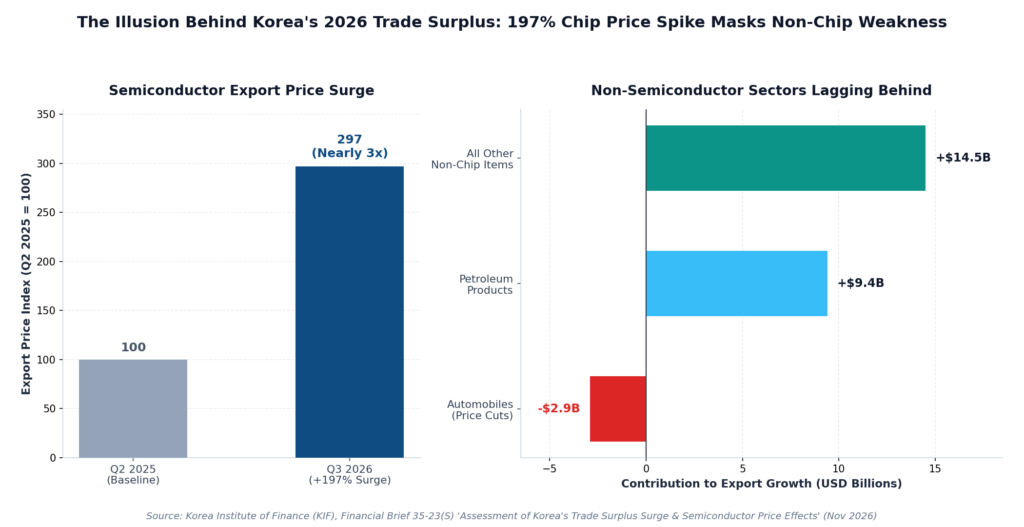
The -$2.9 billion drag in automobiles is particularly telling. Even as memory fabs enjoy historic pricing power, Korean automakers have had to slash prices abroad to defend market share—creating a stark K-shaped split inside Asia’s fourth-largest economy. As a companion KIF analysis on semiconductor spillover effects notes, because chipmaking is intensely capital-intensive, its recovery has yet to spark a full rebound across domestic services or non-chip manufacturing.
Is South Korea Catching “Silicon Dutch Disease”?
In economics, Dutch Disease describes what happens when a booming natural resource—historically North Sea gas in the Netherlands—floods a country with foreign currency, pushes up the domestic exchange rate, and makes every other manufacturing export too expensive to compete globally.
In 2026, KIF explicitly warns that AI memory chips are acting like Korea’s version of North Sea oil:
- Exchange Rate Squeeze: An outsized South Korea trade surplus led by semiconductors exerts appreciation pressure on the Korean won (KRW).
- Margin Erosion for Non-Chip Exporters: Industries already struggling to grow volumes—automobiles, general machinery, petrochemicals, and consumer goods—lose overseas price competitiveness when the won strengthens.
- Hollowing Out of Broad Industrial Vitality: Capital and investor attention concentrate heavily in two memory giants while the rest of the manufacturing base battles thinner margins.
The Snap-Back Risk: What Happens When Memory Prices Cool?
Every semiconductor cycle eventually turns. When the South Korea trade surplus is built on +197% unit price inflation rather than diversified volume growth, the downside is symmetrical and fast.
KIF highlights a critical macro cliff: if global AI capex normalizes or new memory supply pulls chip prices back down, the South Korea trade surplus could evaporate rapidly. Because non-chip sectors like autos are already under pricing pressure, there is little buffer to absorb a sudden semiconductor price correction—a vulnerability compounded by Korea’s growing exposure to China, which we examined in our deep dive on Korea-China semiconductor trade dependence.
How Policymakers and Investors Can Turn a Windfall Into Durable Growth
KIF’s conclusion is not fatalistic—it is a strategic call to action. A stronger won and a temporary chip-price windfall do not have to end in Dutch Disease if the surplus is recycled productively:
- Channel Won Strength Into Real Capex: Lower import costs for advanced machinery, energy, and AI tools give Korean non-chip manufacturers a window to modernize plants and lift total-factor productivity.
- Watch Price-Adjusted Trade [invalid URL] Macro investors analyzing KRW assets or Korean equities (KOSPI) should track real export volume indices (such as physical container throughput at Busan Port) and non-chip earnings revisions—not just headline monthly trade surplus dollars.
- Prepare for Cycle Normalization: Policymakers must avoid locking in permanent fiscal or currency assumptions based on peak 2026 memory pricing, ensuring the South Korea trade surplus translates into long-term industrial resilience.
Q1: Why did the South Korea trade surplus surge so sharply in 2026?
According to the Korea Institute of Finance (KIF), the 2026 South Korea trade surplus surged primarily because semiconductor export prices jumped 197% in Q3 2026 compared to Q2 2025 due to global AI demand, rather than a major jump in real export volume.
Q2: What is "Silicon Dutch Disease" in South Korea?
It refers to KIF’s warning that an outsized semiconductor-driven trade surplus can push up the Korean won (KRW), eroding the overseas price competitiveness of non-semiconductor industries—such as automobiles, which already posted a -$2.9 billion export contribution due to price cuts.
Q3: What happens to Korea's trade balance if semiconductor prices fall?
Because the 2026 surplus rests largely on price effects rather than volume growth, KIF warns that a downward reversal in memory chip prices could trigger a rapid contraction in South Korea’s overall trade surplus.