

Key Takeaway: In 2026, Korea-China semiconductor trade has reached an unprecedented inflection point. According to a November 2026 report by the Korea Institute for Industrial Economics & Trade (KIET)
, semiconductors surged to 38.8% of South Korea’s total exports in June 2026 (up from 24.5% in 2025). While chips generated an estimated $39.0 billion bilateral surplus with China in H1 2026, Korea faces acute dual vulnerability: 81.2% of its chip exports to China are concentrated in memory, 12 of 23 high-dependence semiconductor import items rely on China, and Chinese rivals CXMT (10% DRAM) and YMTC (14% NAND) are rapidly gaining global share.
The Paradox Behind South Korea’s Biggest Semiconductor Boom Ever
On the surface, South Korea’s semiconductor engine has never looked more unstoppable. Total global semiconductor exports more than tripled from $54.0 billion in 2010 to $176.6 billion in 2025, and climbed to $180.6 billion in June 2026, according to KIET’s China Industrial Economy Brief (distributed via the KDI Economic Information and Education Center).
Yet beneath those record-breaking headlines lies a structural vulnerability that policymakers in Seoul can no longer ignore. By June 2026, semiconductors alone accounted for 38.8% of South Korea’s entire national exports—a dramatic leap from 24.5% in 2025. Even more striking, South Korea’s overall trade balance with China posted three consecutive years of deficits from 2023 to 2025. The only reason that deficit did not arrive earlier (as far back as 2021) or spiral far deeper was a single lifeline: an annual semiconductor surplus with China hovering around $24 billion to $28.8 billion, which exploded to roughly $39.0 billion in the first half of 2026 alone.
When one product line props up an entire bilateral trade relationship with your largest trading partner, a boom is not just a windfall—it is a single point of failure.
How Concentrated Is Korea-China Semiconductor Trade in 2026?
The KIET study—which maps the entire semiconductor ecosystem across chips, wafers, equipment, and raw materials using OECD (2025) HS classifications—exposes an extreme lack of diversification.
In the first half of 2026, South Korea exported $58.6 billion in semiconductors to China, already surpassing its full-year 2025 total of $53.2 billion as AI-driven DRAM and High Bandwidth Memory (HBM) prices surged. Meanwhile, semiconductor imports from China reached $19.7 billion in H1 2026 (81% of 2025’s full-year $24.4 billion).
| Metric | 2010 | 2025 | 2026 (H1 / Jun) | Strategic Signal |
| Korea Global Chip Exports | $54.0B | $176.6B | $180.6B (Jun) | Memory accounts for 68.4% ($123.5B) |
| Chip Share of Korea Total Exports | — | 24.5% | 38.8% (Jun) | Extreme single-sector export reliance |
| Korea Chip Exports to China | $17.2B | $53.2B | $58.6B (H1) | H1 2026 already beat all of 2025 |
| Korea Chip Imports from China | $6.8B | $24.4B | $19.7B (H1) | Reached 81% of 2025 full-year volume |
| Korea-China Chip Trade Surplus | $10.4B | $28.8B | ~$39.0B (H1) | Sole buffer offsetting non-chip deficits |
| Memory Share in China Chip Exports | — | 60.0% | 81.2% (H1) | Heavily skewed toward DRAM (71% in 2025) |
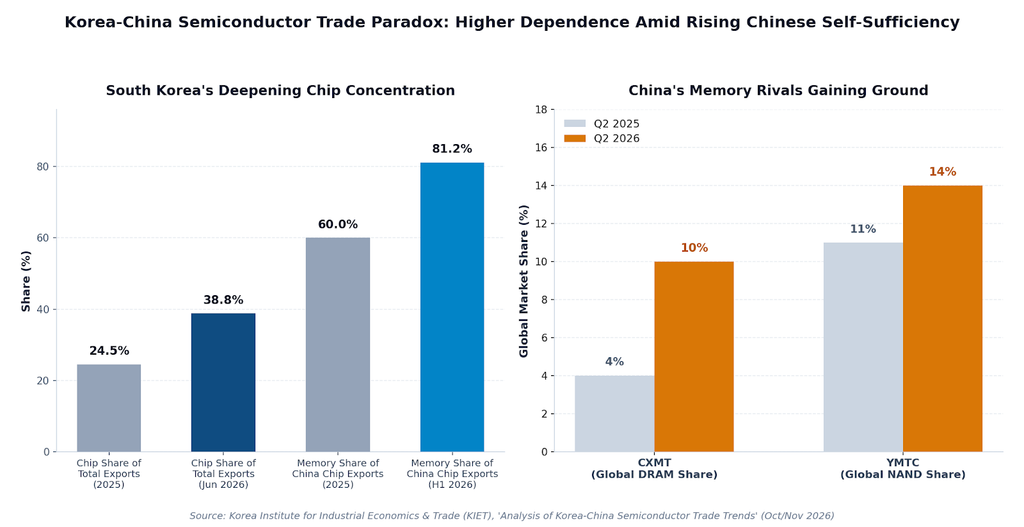
The product mix reveals an even sharper imbalance. While South Korea’s global semiconductor trade follows a “memory export, system-chip and equipment import” model (with Taiwan’s TSMC drawing surging HBM packaging exports and Japan supplying 30.6% of materials and 23.5% of equipment), its bilateral trade with China is overwhelmingly memory-on-memory. In H1 2026, memory accounted for 81.2% of Korea’s chip exports to China and 75.8% of its chip imports from China. Inside that bucket, DRAM alone represented 71% of Korea’s memory exports to China in 2025, while DRAM ($7.7B, 54%) and Multi-Chip Packages (MCP, $5.1B, 36%) dominated imports.
The Hidden Supply Chain Chokepoint: 12 of 23 Critical Import Items Depend on China
Most Western headlines frame the chip war purely around advanced lithography equipment and export controls. KIET’s HS 6-digit dependency audit highlights a quieter, equally dangerous bottleneck running in the opposite direction.
Filtering for semiconductor ecosystem items with over $1 million in trade where a single country supplies 50% or more of imports, KIET identified 23 high-dependence import items for South Korea. Twelve of those 23 items—more than half—are dependent on China, including:
- Critical Raw Materials: Gallium, germanium, indium, silicon carbide (SiC), and niobium-gallium products.
- Discrete Components & Materials: Diodes, discrete semiconductor components, and photosensitive plates/films.
- Finished Memory & Packaging: Legacy memory and MCP modules tied to Korean fabs operating in China.
By contrast, China has only 8 high-dependence semiconductor import items, 6 of which are concentrated in Japan (wafer manufacturing equipment, specialty photographic chemicals, and high-purity raw materials). That asymmetry means Beijing holds upstream raw-material leverage over Korean fabs even as Seoul holds downstream advanced-memory leverage over Chinese tech firms.
CXMT at 10%, YMTC at 14%: China’s Memory Catch-Up Is No Longer Theoretical
For years, analysts assumed China’s semiconductor self-sufficiency drive (“Big Fund” investments and localization mandates) would remain trapped in trailing-edge logic. KIET’s latest market-share benchmarks show that cushion is eroding fast:
- CXMT (ChangXin Memory Technologies): Global DRAM market share more than doubled in a single year, climbing from 4% in Q2 2025 to 10% in Q2 2026.
- YMTC (Yangtze Memory Technologies): Global NAND flash share expanded from 11% in Q2 2025 to 14% in Q2 2026.
Because 6.7% of South Korea’s entire national exports consist of semiconductors sold to China (compared to just 0.7% of China’s total exports being chips sold to Korea), Beijing’s localization push creates an asymmetric shock. As CXMT and YMTC capture legacy and mid-tier memory demand inside China, Korean chipmakers face intensifying price competition unless they stay permanently ahead in cutting-edge tiers like Samsung’s next-gen 3D memory and HBM4E and SK hynix’s 12-layer HBM4E.
Why Headline Trade Numbers Miss Half the Story: The Hong Kong & Processing-Trade Gap
Investors tracking monthly Korean customs data often misread actual Chinese chip demand because of a massive statistical discrepancy highlighted by KIET:
- Memory Gap: In 2024, China reported $45.2 billion in memory imports from Korea—roughly 1.7 times Korea’s direct reported memory exports to China ($25.8 billion). Adding Korea’s exports to Hong Kong closes most of that gap.
- System Chip Gap: China reported $38.7 billion in system-semiconductor imports from Korea, more than double Korea’s direct export figure ($16.4 billion), pointing to heavy transshipment through Singapore, Taiwan, and Vietnam.
- Processing & Bonded Trade Dominance: Within China’s IC trade with Korea, 51.2% is processing trade (assembly/packaging in China) and 30.2% is bonded warehouse logistics, while ordinary general trade accounts for just 18.5%.
For global investors and supply-chain planners, tracking Korea’s customs data alone without cross-checking Chinese import statistics and Hong Kong/ASEAN transshipments leaves a blind spot worth tens of billions of dollars.
What This Means for Global Tech Investors & Supply Chains
South Korea’s 38.8% semiconductor export share is both a testament to its irreplaceable role in the global AI infrastructure boom and a warning siren. To avoid a sudden cliff when China’s domestic memory capacity matures or AI data-center spending cools, KIET emphasizes three imperatives:
- Defend the “Super-Gap” in High-Value AI Memory: Shift capacity aggressively from commodity DRAM/NAND into custom HBM, HBM4E, and high-density 3D NAND where Chinese rivals still face yield and lithography hurdles.
- De-Risk Upstream Raw Materials: Diversify sourcing and recycling for the 12 China-dependent HS-6 items—especially gallium, germanium, indium, and SiC.
- Expand Beyond Bilateral Memory Trade: Capture growth in Physical AI (robotics, drones, autonomous vehicles) and diversify export corridors toward Taiwan’s advanced packaging ecosystem, North America, and Southeast Asia.
Bottom Line: Watching Korea-China Semiconductor Trade in 2027
Ultimately, Korea-China semiconductor trade is entering a decisive stress test. While AI server demand continues to boost headline customs figures, the structural risks embedded in Korea-China semiconductor trade—from 81.2% memory concentration to 12 China-dependent raw-material chokepoints—require investors to look far beyond monthly export totals. For ongoing data-driven briefings on Korea-China semiconductor trade and Asia’s macro shifts, explore our latest research at SeoulResearch.
Q1: What percentage of South Korea's exports are semiconductors in 2026?
As of June 2026, semiconductors accounted for 38.8% of South Korea’s total exports, surging from 24.5% in 2025, driven by global AI data-center demand and soaring memory prices (KIET, 2026).
Q2: How much market share do Chinese memory makers CXMT and YMTC hold in 2026?
According to KIET data, CXMT’s global DRAM market share rose from 4% in Q2 2025 to 10% in Q2 2026, while YMTC’s global NAND flash share climbed from 11% to 14% over the same period.
Q3: Why do Korea's chip export figures to China differ from China's import statistics?
Statistical gaps stem from Hong Kong re-exports, third-country transshipments (via Singapore, Taiwan, and Vietnam), FOB vs. CIF valuation differences, and the fact that 81.4% of China’s IC trade with Korea occurs through processing trade (51.2%) and bonded trade (30.2%) rather than general trade (18.5%).