
The ISSCC 2027 memory chip war has redrawn the global semiconductor map. According to the ISSCC 2027 Korea Committee and The Elec (Nov 25, 2026), China captured 45.3% of all accepted papers (124 of 274) while Huawei unveiled a 5-layer hybrid-bonded custom HBM (cHBM) and CXMT showcased 32Gb vertical-gate DDR5 right beside Samsung’s HBM4E and SK hynix’s next-gen DRAM. The same day, SK hynix plunged 11.05% and Samsung fell 9.87%, extending 3-month losses to -39.0% and -34.7%, raising urgent parallels to South Korea’s historic LCD retreat.
Why the ISSCC 2027 Memory Chip War Just Rattled Global Markets
For decades, the International Solid-State Circuits Conference (ISSCC)—often called the “Semiconductor Olympics”—has operated under one strict rule: simulations do not qualify. To get a paper accepted at ISSCC 2027 (San Francisco, Feb 14–18, 2027), companies must fabricate working silicon and present real physical measurements.
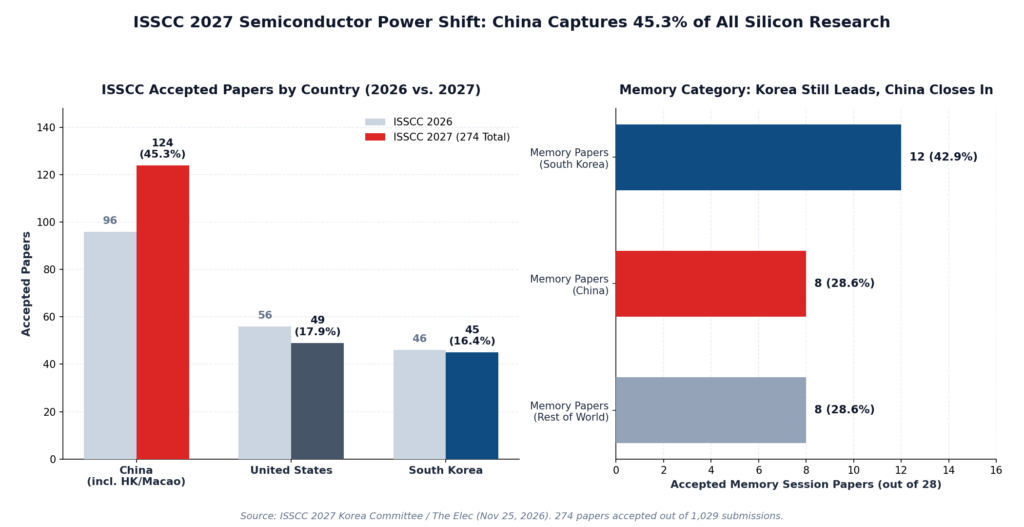
That is why the advance program revealed on November 25, 2026 sent a chill through Seoul and Wall Street alike. Out of 1,029 submissions, 274 papers were accepted—and China (including Hong Kong and Macao) claimed 124 papers, or 45.3% of the entire conference, surging from 96 a year earlier (The Elec). The United States dropped from 56 to 49 papers (17.9%), while South Korea slipped from 46 to 45 papers (16.4%).
More alarming for investors in Korean tech giants, the ISSCC 2027 memory chip war is no longer confined to trailing-edge commodity memory. On February 16, 2027, inside the exact same memory session, Huawei will take the podium immediately after Samsung Electronics to unveil a custom High Bandwidth Memory (cHBM) chip built with 5-layer wafer hybrid bonding and an integrated memory controller (The Elec Korea). Right alongside them, China’s CXMT and Korea’s SK hynix will present competing Vertical-Gate (VG) DDR5 architectures back-to-back.
Inside the Silicon Showdown: Samsung and SK hynix vs. Huawei and CXMT
South Korea still holds the crown in the dedicated memory track, winning 12 of 28 accepted memory papers compared to China’s 8, with Samsung tying MediaTek for the most corporate papers globally (5 each). Yet a side-by-side look at the hardware being presented shows how dangerously close the technical frontier has become.
ISSCC 2027 Head-to-Head Memory Specs
| Company | Technology Unveiled at ISSCC 2027 | Verified Key Specifications | Strategic Battleground |
| Samsung Electronics | 7th-Gen HBM4E & 4nm cHBM Interface | 48GB capacity, 17 Gb/s per pin (vs. HBM4 36GB / 11.7 Gb/s) | Flagship AI GPU memory leadership |
| Huawei | Custom HBM (cHBM) | Memory controller integrated into HBM via 5-layer hybrid bonding | Domestic Chinese AI accelerator stack |
| SK hynix | Vertical-Gate (VG) DDR5 DRAM | 16Gb DDR5 using wafer fusion bonding & Deep Silicon Via (DSV) | Next-gen high-density server DRAM |
| CXMT | Vertical-Gate DDR5 & LPDDR6 | 32Gb DDR5 (hybrid bonding, 9.2 Gb/s); LPDDR6 at 17.6 Gb/s | Direct challenge to Korea’s DRAM core |
| Samsung Electronics | 500-Layer (5XX) 3D TLC NAND | 1.5Tb, wafer bonding, 42 Gb/mm², 6.8 Gbps I/O, 290 MB/s write | Ultra-dense AI data-center SSDs |
| SK hynix | 375-Layer 3D TLC NAND | 1Tb TLC NAND, 4.8 Gbps I/O | Enterprise AI storage efficiency |
Sources: The Elec (Nov 25, 2026) and ETNews (Nov 25, 2026).
Samsung’s 500-layer 3D NAND—packing 42 gigabits per square millimeter (roughly a full HD movie inside a 1mm × 1mm square) using wafer bonding to separate heat-sensitive peripheral circuits from memory cells—proves Korea still commands an engineering lead (ETNews). Meanwhile, global logic and networking players are pushing the surrounding AI stack just as hard: TSMC is presenting a 1.6nm-class (A16) 64 Gb/s UCIe interface, AMD is unveiling a vertically stacked 7nm/65nm optical link, Marvell is showing a 2nm 1.6 Tb/s coherent optical transceiver, and NVIDIA is showcasing a 7nm single-wire bidirectional chip-to-chip link.
The takeaway is unmistakable: in the ISSCC 2027 memory chip war, resting on yesterday’s HBM3E or DDR5 margins is no longer an option.
Have We Seen This Movie Before? The Uncomfortable Lesson of Korea’s LCD Retreat
Whenever investors ask whether Chinese semiconductor challengers can truly erode Korean dominance, history offers a sobering blueprint: the global display industry from 2016 to 2025.
Ten years ago, South Korea’s Samsung Display and LG Display ruled the global LCD television market with commanding margins and superior manufacturing yields. Chinese state-backed rivals—led by BOE and TCL’s CSOT—entered at the low end, absorbed years of heavy capital losses, scaled massive Generation 8.5 and 10.5 fabs, and flooded global supply.
What happened next was decisive:
- Margins Collapsed in Commodity Tiers: Relentless Chinese volume expansion pushed large-size LCD panel prices below Korean production costs.
- Samsung Exited Completely: Samsung Display sold its Suzhou 8.5G LCD fab to CSOT in 2020 and shut down its final Asan TV LCD lines in June 2022, pivoting aggressively into high-margin QD-OLED (IT Chosun).
- LG Followed Suit: After halting domestic TV LCD output in 2022, LG Display finalized the sale of its Guangzhou 8.5G LCD plant to CSOT in April 2025 for KRW 2.25 trillion ($1.7 billion).
- China Captured the Volume Base: Today, China manufactures roughly 52% of global LCD panels, forcing Korean display makers to defend an ever-narrowing premium OLED fortress.
Why Memory Is Similar—and Where It Differs
The ISSCC 2027 memory chip war echoes the early innings of the LCD cycle: as KIET’s latest semiconductor trade data confirms, CXMT’s global DRAM share already jumped from 4% in Q2 2025 to 10% in Q2 2026, while YMTC’s NAND share climbed from 11% to 14%.
However, memory has two critical shields that LCD never had: extreme EUV lithography barriers (which remain restricted by U.S. export controls) and tight co-design integration with NVIDIA and TSMC for HBM4/HBM4E. That means Korea is unlikely to be wiped out of AI memory—but just like in LCD, conventional DRAM and commodity NAND margins are structurally vulnerable once Chinese supply scales in 2027–2028.
Stock Market Impact: Why SK hynix, Samsung, and Micron Are Down 35–39% Despite Record Profits
Here is the paradox bewildering retail investors in November 2026: memory chipmakers have never been more profitable on paper. In Q3 2026 alone, SK hynix posted KRW 83.3 trillion in operating profit (an astonishing 80% operating margin), while Samsung Electronics generated KRW 107.4 trillion in operating profit (Admirals Market Analysis).
Yet stock markets do not price last quarter’s profits—they price the supply curve 18 months ahead.
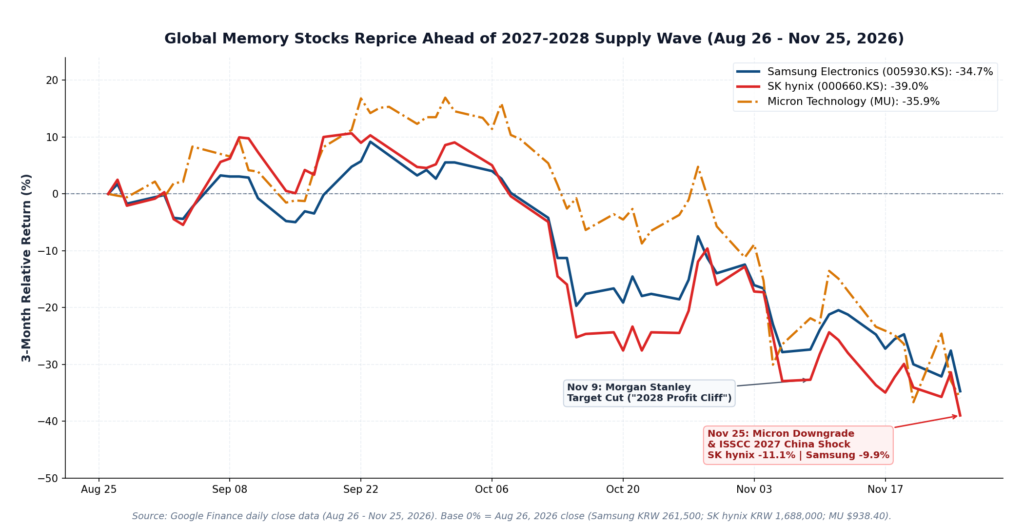
Over the past three months (August 26 to November 25, 2026), global memory stocks have suffered a brutal valuation reset, culminating on November 25, 2026, when SK hynix plunged 11.05% to KRW 1,030,000, Samsung Electronics dropped 9.87% to KRW 170,700, and the KOSPI sank 6.16%, triggering its 62nd program-trading sidecar of the year.
Key Listed Stocks Hit by the Memory Repricing (As of Nov 25–26, 2026)
| Stock (Ticker) | Nov 25 Close (3-Month Return) | Trailing P/E | Wall Street Catalyst & Risk |
SK hynix (000660.KS) | KRW 1,030,000 (-38.98%) | 4.04× | Goldman Sachs cut target from KRW 3.5M to KRW 2.0M (Nov 22); Morgan Stanley cut to KRW 1.6M |
Samsung Electronics (005930.KS) | KRW 170,700 (-34.72%) | 5.43× | Goldman cut target from KRW 500K to KRW 350K; faces HBM4E execution & U.S. tariff scrutiny |
Micron Technology (MU, NASDAQ) | $601.25 (-35.93%) | 8.09× | BNP Paribas Exane cut to Neutral & slashed target from $1,700 to $775 (Nov 24); Q1 earnings Dec 17 |
Source: Google Finance (Nov 26, 2026) and Admirals / The Korea Times.
Why did Wall Street slash targets across the board? Three catalysts collided right alongside the ISSCC 2027 memory chip war headlines:
- 2027–2028 Supply Wave: Goldman Sachs forecasts the global DRAM supply deficit to narrow sharply from 5.1% in 2027 to 1.2% in 2028 as new fabs—and China’s CXMT—ramp output.
- NAND Price Softness: TrendForce warned on November 19 that NAND contract prices could slip 0% to 5% in Q1 2027 as Chinese cloud buyers trim orders.
- Valuation Trap vs. Deep Value: At 4.0× to 5.4× trailing earnings, SK hynix and Samsung look absurdly cheap—classic cyclical peak-earnings multiples where stocks either rebound violently once oversupply fears prove overblown, or grind lower if Morgan Stanley’s warned “2028 profit cliff” materializes.
(Related Reading on SeoulResearch: Check our deep dives on Korea-China semiconductor export concentration and why a 197% chip price spike is masking risks in South Korea’s trade surplus — [https://seoulresearch.com/korea-china-semiconductor-trade-dependence-2026/], [https://seoulresearch.com/south-korea-trade-surplus-2026/])
What This Means for Your Wallet, Tech Bills, and Investment Portfolio
It is easy to treat a San Francisco chip conference or a Seoul stock sell-off as distant financial noise. In reality, the ISSCC 2027 memory chip war directly affects everyday consumers and global retail investors in three concrete ways:
1. Relief Coming for PC, Smartphone, and Cloud Storage Prices
Over the past year, skyrocketing memory prices—up nearly 3× in Korean export indices—pushed up the bill of materials for AI laptops, flagship smartphones, and enterprise SSDs. If TrendForce’s Q1 2027 NAND dip and CXMT’s expanding DRAM supply cool conventional memory pricing in 2027, consumers upgrading laptops, gaming PCs, and SSD storage should finally see component prices stabilize or drop.
2. Lower AI Inference Costs Over Time
Samsung’s 500-layer 3D NAND (6.8 Gbps I/O) and HBM4E (17 Gb/s per pin) are designed to smash the “memory wall” that makes running AI agents and reasoning models so expensive. Faster, denser memory per watt helps hyperscalers lower data-center energy and serving costs—gradually keeping consumer and business AI subscription fees in check.
3. A Stress Test for Tech ETFs and 401(k)/ISA Portfolios
Even if you have never bought a single Korean stock, you likely own exposure to this battle through major ETFs:
- Semiconductor ETFs (
SMH,SOXX): Heavily weighted toward Micron, NVIDIA, TSMC, and equipment makers (ASML, Applied Materials, Lam Research) that sell into both Korean and global fab expansions. - Korea & Emerging Market ETFs (
EWY,EEM): Samsung Electronics and SK hynix alone represent roughly half of South Korea’s equity market capitalization, meaning memory swings dictate the entire index.
3-Point Investor Checklist for December 2026 – Q1 2027
- Mark December 17, 2026 (Micron Q1 Earnings): Micron reports weeks ahead of Samsung and SK hynix; its gross-margin guidance for 2027 HBM and NAND will set the tone for the entire sector.
- Separate HBM from Commodity Memory: Watch whether hyperscaler AI capex keeps 2027 HBM fully sold out even if legacy DDR4/DDR5 and consumer NAND soften.
- Track ISSCC 2027 Demonstrations (Feb 14–18, 2027): Pay close attention to whether Huawei’s 5-layer cHBM and CXMT’s vertical-gate DDR5 show commercially viable yields—or remain lab showcases constrained by equipment bottlenecks.
Final Verdict on the ISSCC 2027 Memory Chip War
The ISSCC 2027 memory chip war is no longer an academic preview—it is already repricing trillions of won in market value across Seoul and Wall Street. While South Korea’s lead in HBM4E and 500-layer NAND keeps its high-end moat intact, the ISSCC 2027 memory chip war proves that Chinese challengers are compressing the technology gap faster than consensus models assumed. For investors and consumers alike, watching how the ISSCC 2027 memory chip war plays out from Micron’s December earnings to San Francisco in February will be essential for navigating 2027’s tech cycle.
Q1: Why is ISSCC 2027 so important for the global memory chip war?
ISSCC only accepts papers backed by fabricated, physically measured silicon—not simulations. At ISSCC 2027, China captured 45.3% of all accepted papers (124 of 274), and Huawei and CXMT are presenting custom HBM and vertical-gate DDR5 in the same session as Samsung and SK hynix.
Q2: Why did SK hynix and Samsung stock fall nearly 35–39% over three months despite record profits?
Memory stocks trade on future supply-demand expectations rather than trailing earnings. Investors sold off SK hynix (-39.0%), Micron (-35.9%), and Samsung (-34.7%) following Wall Street target cuts, TrendForce’s softer Q1 2027 NAND outlook, and fears of a 2027–2028 supply wave from new fabs and Chinese rivals like CXMT.
Q3: Could South Korea lose the memory market to China the way it exited LCD displays?
Korea faces rising margin pressure in commodity DRAM and NAND—similar to how Chinese rivals forced Samsung Display (2022) and LG Display (2025) out of TV LCDs. However, U.S. EUV export controls and deep HBM4E co-design ties with NVIDIA and TSMC give Korean chipmakers a far stronger technological moat in high-end AI memory.